Why this comparison matters more in 2026
The Master of Computer Applications (MCA) remains one of the most recognised postgraduate pathways into software development, IT systems, and digital infrastructure roles. But the mode of pursuing MCA has diversified. Students now choose between online MCA programs and MCA distance education formats.
The debate is no longer about whether MCA is relevant—it clearly is. The question has shifted toward: Which learning model builds stronger academic grounding, discipline, and long-term career credibility?
In regions such as Meerut, Noida, Ghaziabad, Hapur, Delhi, Saharanpur, and Muzaffarnagar, learners exploring MCA distance learning options often weigh flexibility, fees, eligibility, and government recognition carefully before making a decision.
This comparison is therefore not superficial. It affects academic rigour, regulatory validity, cost structure, and long-term professional perception.
Takeaway: The right MCA format is not about convenience—it is about alignment with academic depth and career strategy.
- What is MCA Distance Education?
- What is Online MCA?
- Difference Between Distance MCA and Online MCA
- Eligibility Criteria in ODL or Online
- MCA Fees Difference in Online and ODL
- MCA Syllabus: Common Differences
- Distance MCA vs Online MCA Validity
- Distance MCA or Online MCA – Which Is Better?
- Career Growth in IT
- FAQs
- Conclusion
What is MCA Distance Education?
The Distance Learning MCA operates under the Open and Distance Learning (ODL) framework regulated by the University Grants Commission (UGC-DEB).
It typically includes:
- Self-learning study materials
- Structured semester system
- Periodic academic support
- Defined examination centres
- Controlled assessment systems
Chaudhary Charan Singh University Distance Education has long-established ODL frameworks that prioritise academic structure and regulatory compliance.
Distance MCA focuses heavily on:
- Conceptual clarity
- Independent study discipline
- Formal evaluation processes
What is Online MCA?
An online MCA is delivered through digital platforms using recorded lectures, live sessions, digital assignments, and online proctored examinations.
Online formats emphasise:
- Interactive digital learning
- Continuous online engagement
- Technology-enabled assessments
- Immediate digital feedback systems
While online MCA aligns well with IT workflows, its structure depends significantly on digital infrastructure and learner self-management.
Difference Between Distance MCA and Online MCA
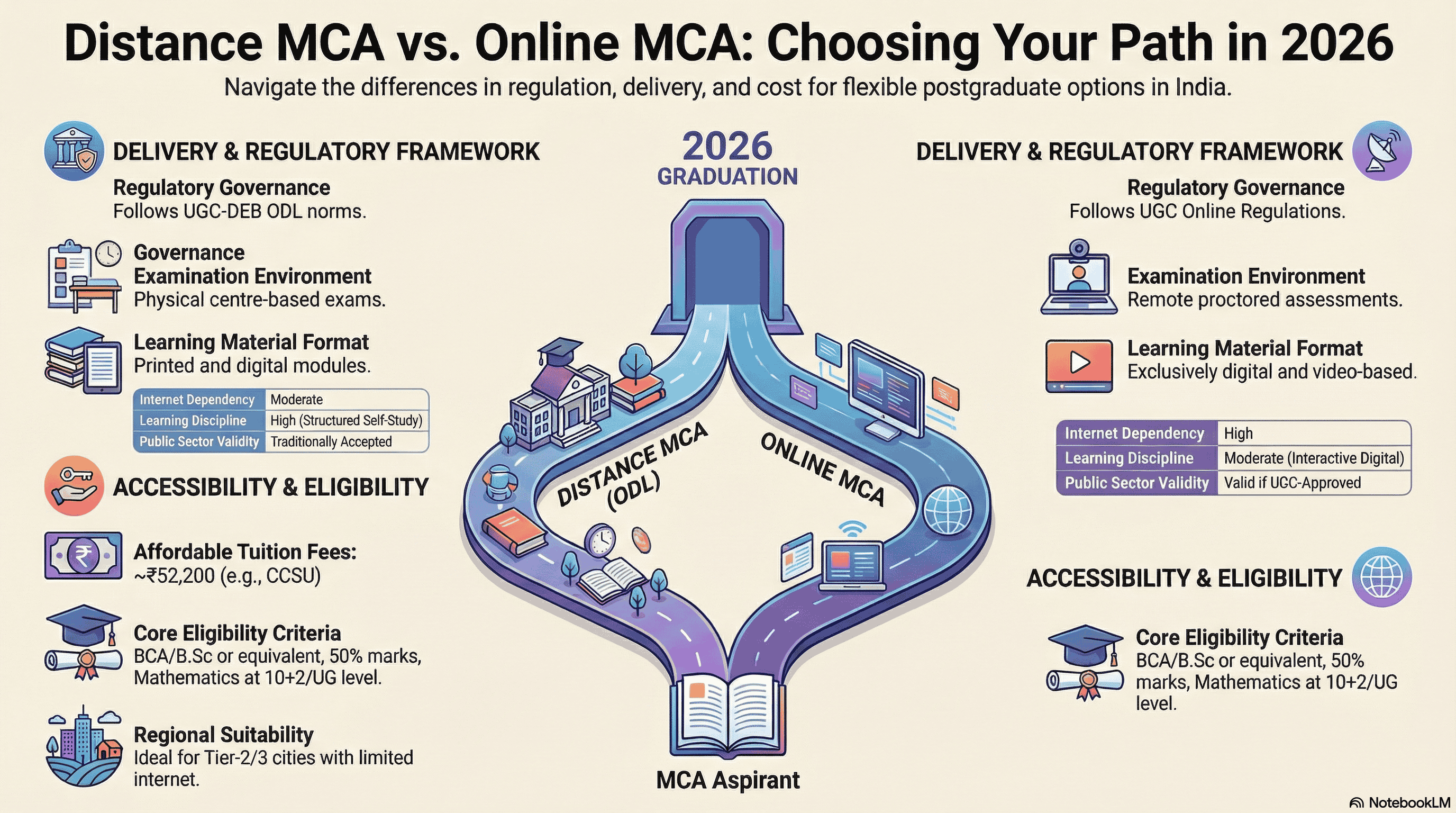
The differences are often misunderstood. Both are non-campus formats, but their regulatory and academic delivery frameworks differ.
Below is a structured comparison:
| Parameter | Distance MCA (ODL) | Online MCA |
|---|---|---|
| Regulatory Framework | Governed under UGC-DEB ODL norms | Governed under UGC Online Regulations |
| Learning Materials | Printed & digital self-learning modules | Fully digital learning system |
| Academic Discipline | Strong emphasis on structured self-study | Emphasis on interactive digital sessions |
| Examination Mode | Usually, centre-based term-end exams | Online proctored exams |
| Learning Independence | High | Moderate to high |
| Internet Dependency | Moderate | High |
| Cost Structure | Generally lower | Often slightly higher |
| Accessibility | Suitable for regions with limited connectivity | Requires consistent internet access |
| Perception in the Public Sector | Traditionally accepted | Increasingly accepted |
| Suitability for Government Jobs | Strong compliance under ODL norms | Valid if UGC-approved |
Distance MCA offers structured academic autonomy with lower technological dependency.
What are the Eligibility Criteria in ODL or Online?
Admission criteria for both formats are largely aligned, but clarity matters. Applicants must have studied Mathematics either at the 10+2 level or during undergraduate studies. Additionally, candidates should hold a BCA, B.Sc. (Computer Science/IT/Computer Applications), or an equivalent qualification with at least 50% aggregate marks. A 5% relaxation in minimum marks is applicable for candidates belonging to reserved categories (SC/ST).
This applies across many MCA admission frameworks.
What is the MCA Fees Difference in Online and ODL?
Cost is often a deciding factor. The total fee for the Distance MCA program is ₹52,200 , making it a comparatively affordable postgraduate option in computing.
When evaluating the MCA fees, distance education typically:
- Eliminates high digital infrastructure charges
- Offers lower tuition compared to many online MCA programs
- Reduces relocation and living costs
This affordability often makes ODL MCA more accessible to students in Tier-2 and Tier-3 cities.
MCA Syllabus: What are the Common Differences between Online and ODL Formats?
Academically, both formats often follow similar core subject structures, including:
- Programming languages
- Data structures
- Database management systems
- Software engineering
- Operating systems
- Computer networks
- Web technologies
However, the key difference lies in delivery.
Distance MCA:
- Emphasises structured textual learning
- Encourages independent conceptual mastery
- Maintains formal academic evaluation
Online MCA:
- Emphasises recorded/live lectures
- Relies on digital engagement
- Integrates real-time interaction
Controlled contradiction: Online MCA appears technologically aligned with IT careers. Yet, distance MCA's structured academic depth and disciplined self-learning often build stronger independent problem-solving capability—an essential IT skill.
Distance MCA vs Online MCA Validity
Distance MCA programs governed under UGC-DEB are valid for employment, higher education, and government jobs when offered by recognised universities. Online MCA programs are valid if approved under the UGC online regulations.
Validity depends on regulatory compliance—not delivery style.
FAQ: Is Distance MCA valid for government jobs?
Yes. A distance MCA degree from a recognised university operating under UGC-DEB guidelines is valid for government employment.
Distance MCA or Online MCA – Which Is Better?
The question depends on the learner context. Distance MCA is often better suited for:
- Students in regions like Meerut, Noida, Ghaziabad, Hapur, Delhi, Saharanpur, Muzaffarnagar
- Learners seeking affordability
- Candidates preparing for competitive examinations
- Students preferring structured self-study
Online MCA may suit:
- Working professionals comfortable with digital classrooms
- Learners seeking interactive video-based engagement
Reach out to us for further clarification.
Contact Us →From a long-term academic discipline perspective, distance learning MCA often provides a stronger independent study orientation.
Career Growth in IT Depends On:
- Programming ability
- Practical exposure
- Continuous upskilling
- Industry certifications
FAQs
Regular MCA offers campus immersion, but distance and online MCA provide flexibility. The choice depends on personal learning style, financial capacity, and career stage.
Yes, if the online MCA is UGC-approved and awarded by a recognised university, it is academically equivalent.
There is typically no structural salary difference purely based on mode of study. Employers evaluate skill proficiency, project experience, and technical competence more than delivery format.
Conclusion
The difference between distance MCA and online MCA lies primarily in delivery structure, technological dependency, and cost orientation—not in academic legitimacy when governed by UGC norms. Distance MCA, particularly under established ODL frameworks such as those associated with universities like Chaudhary Charan Singh University, offers structured academic discipline, affordability, and strong regulatory acceptance. Online MCA aligns well with digital workflows but requires sustained internet access and digital engagement.
For students seeking cost-effective postgraduate computing education with recognised validity—especially across regions like Meerut, Noida, Ghaziabad, Hapur, Delhi, Saharanpur, and Muzaffarnagar—distance MCA remains a credible and strategically stable choice in 2026.