


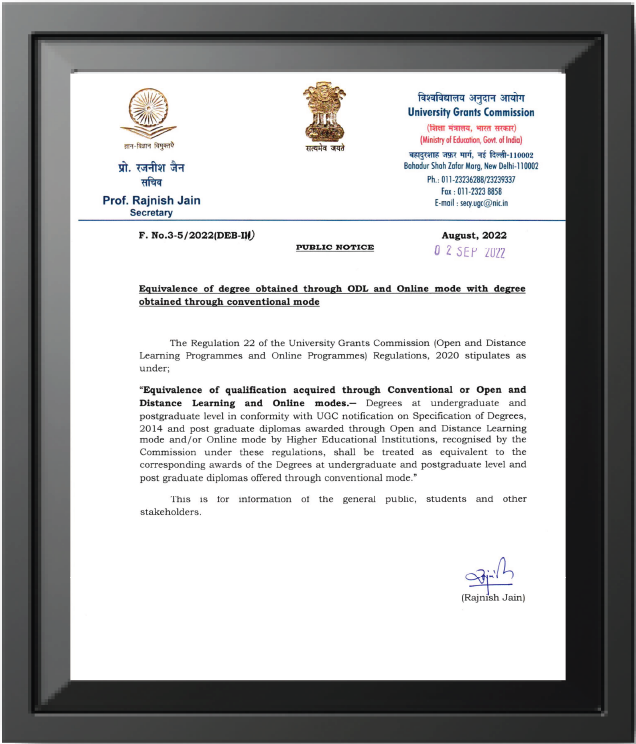
ODL Degree = Regular Degree
-
As per the Regulation 22 of the UGC in 2020, ODL degrees are now regarded as equally valid and credible as traditional, offline degrees.
The distance learning M.Com program from Chaudhary Charan Singh University is designed for graduates aiming to gain advanced knowledge in commerce, finance, and business management through a flexible study mode. The curriculum includes advanced studies in corporate finance, taxation, economics, and management — equipping learners with analytical, research, and problem-solving skills. As one of the leading Masters in Commerce programs, it prepares students for diverse roles in financial services, business operations, and policy development.
| Code | Paper Title | Core Compulsory/ Elective / Value Added |
|---|---|---|
| COM-I-101 | Management Concepts and Organisational Behaviour | Core Compulsory Theory |
| COM-I-102 | Direct Taxes | Core Compulsory Theory |
| COM-I-103 | Statistical Analysis | Core Compulsory Theory |
| COM-I-104 | Research Methodology Or Research Methodology and Statistical Analysis (Swayam portal) | Core Compulsory Theory |
| COM-I-105 | Statistical Analysis (Swayam portal) | Core Compulsory Theory |
| COM-IRP-01 | Industrial Training / Research Project / Survey / Training under Chartered Accountant / Tax Advocate | Core Compulsory Project |
| COM-IRP-110 | Elementary Commerce & Accounts | Minor Open Elective for Other faculty students |
| COM-I -111 | Choose one course either from on E f or Swayam portal (minimum of 4
credits) or university/college pool of minor courses of other faculties (other than commerce) |
Minor Open Elective for Other faculty students |
| Code | Paper Title | Core Compulsory/ Elective / Value Added |
|---|---|---|
| COM-I -201 | Indirect Taxes and GST | Core Compulsory |
| COM-I-202 | Corporate Laws and Governance | Core Compulsory |
| COM-I-203 | Corporate Financial Accounting | Core Compulsory |
| COM-I-204 / COM-I-205 | Any One of these Strategic Management & Business Policy OR Strategic Marketing | Core Compulsory |
| COM-IRP - 02 | Industrial Training/Research Project /Survey / Training under Chartered Accountant / Tax Advocate | Core Compulsory |
| COM-I -210 | Principles of Management | Minor Open Elective for Other faculty students |
| COM-IRP-211 | Choose one course cither from Swayam portal (minimum of 4 credits) or university/college pool of minor courses of other faculties (other than commerce) | Minor Open Elective for Commerce students |
| Code | Paper Title | Core Compulsory/ Elective / Value Added |
|---|---|---|
| COM-I -301 | Financial Management | Core Compulsory |
| COM-I -302 | Marketing Management | Core Compulsory |
| COM-! -303 / COM-I-304 | Human Resource Management OR Human Resource Management (Swayam portal) | Core Compulsory |
| COM-I-305 / COM-I-306 | Any One of these Operations Research OR Managcrial Economics | Core Elective |
| COM-IRP-03 | Industrial Training/Research Project /Survey / Training under Chartered Accountant / Tax Advocate | Core Compulsory |
| Code | Paper Title | Core Compulsory/ Elective / Value Added |
|---|---|---|
| COM-I-401 | Security Analysis and Portfolio Management | Core Compulsory Theory |
| COM-I-402 | Financial System & Capital Market | Core Compulsory Theory |
| COM-I-403 | Banking and Insurance | Core Compulsory Theory |
| COM-I-404 | For Financial System | Core Compulsory Theory |
| COM-I-405 | International Marketing | Core Compulsory Theory |
| COM-I-406 | Consumer Behaviour | Core Compulsory Theory |
| COM-I-407 | Services Marketing | Core Compulsory Theory |
| COM-I-408 | Advertising and Sales Promotion | Core Compulsory Theory |
| COM-I-409 | Industrial Relations & Labour | Core Compulsory Theory |
| COM-I-410 | Corporate Social Responsibility | Core Compulsory Theory |
| COM-I-411 | Recruitment Training & Development | Core Compulsory Theory |
| COM-I-412 | Talent Management & Employee Retention | Core Compulsory Theory |
| COM-IRP-04 | Industrial Training / Research Project (Survey / Training under Chartered Accountant / Tax Advocate) | Core Compulsory Project |
| M.Com | Semester I | Semester II | Semester III | Semester IV | ||
|---|---|---|---|---|---|---|
| Registration Fee | ₹ 200/- | - | - | - | ||
| Semester Fee | ₹ 5,500/- | ₹ 5,500/- | ₹ 5,500/- | ₹ 5,500/- | ||
| Annual Fee | ₹ 11,200/- | ₹ 11,000/- | ||||
| Total Fees | ₹ 22,200/- | |||||
| Note: The above-mentioned fee does not include the 'Examination Fee', which will be applicable each semester. Details of this fee will be communicated to you in due course. | ||||||

Apply Online

Submit Documents

Application Review

Fee Payment

Start Learning
Yes, you can enrol in an M.Com through distance education at CCSU, which offers the program with flexible learning options suitable for working professionals and graduates seeking convenient study modes.
Yes, a distance M.Com from CCSU is valuable because it provides strong academic grounding in commerce and is widely accepted for career advancement, competitive exams, and further studies.
Yes, the distance M.Com course is valid for both government and private sector jobs since it is offered by a UGC-recognized university.
Yes, the distance M.Com course is valid for both government and private sector jobs since it is offered by a UGC-recognized university.
The M.Com distance education fees at CCSU are ₹22,200 in total, with the registration fee of ₹200. For year-wise or updated details, students can refer to the university website.
The distance M.Com course includes subjects like accounting, economics, finance, taxation, corporate law, and business management.
Graduation in Commerce or Management with 55% marks (Gen); 5% relaxation for SC/ST.
Yes, graduates of a distance learning M.Com from CCSU are eligible for most government job exams.
Yes, the M.Com in distance education is ideal for working professionals as it offers flexibility in learning while enhancing qualifications.
Yes, learners who wish to apply commerce and finance concepts in real organisational settings may explore the M.Com Internship , which combines academic learning with structured exposure to corporate, financial, or accounting environments.