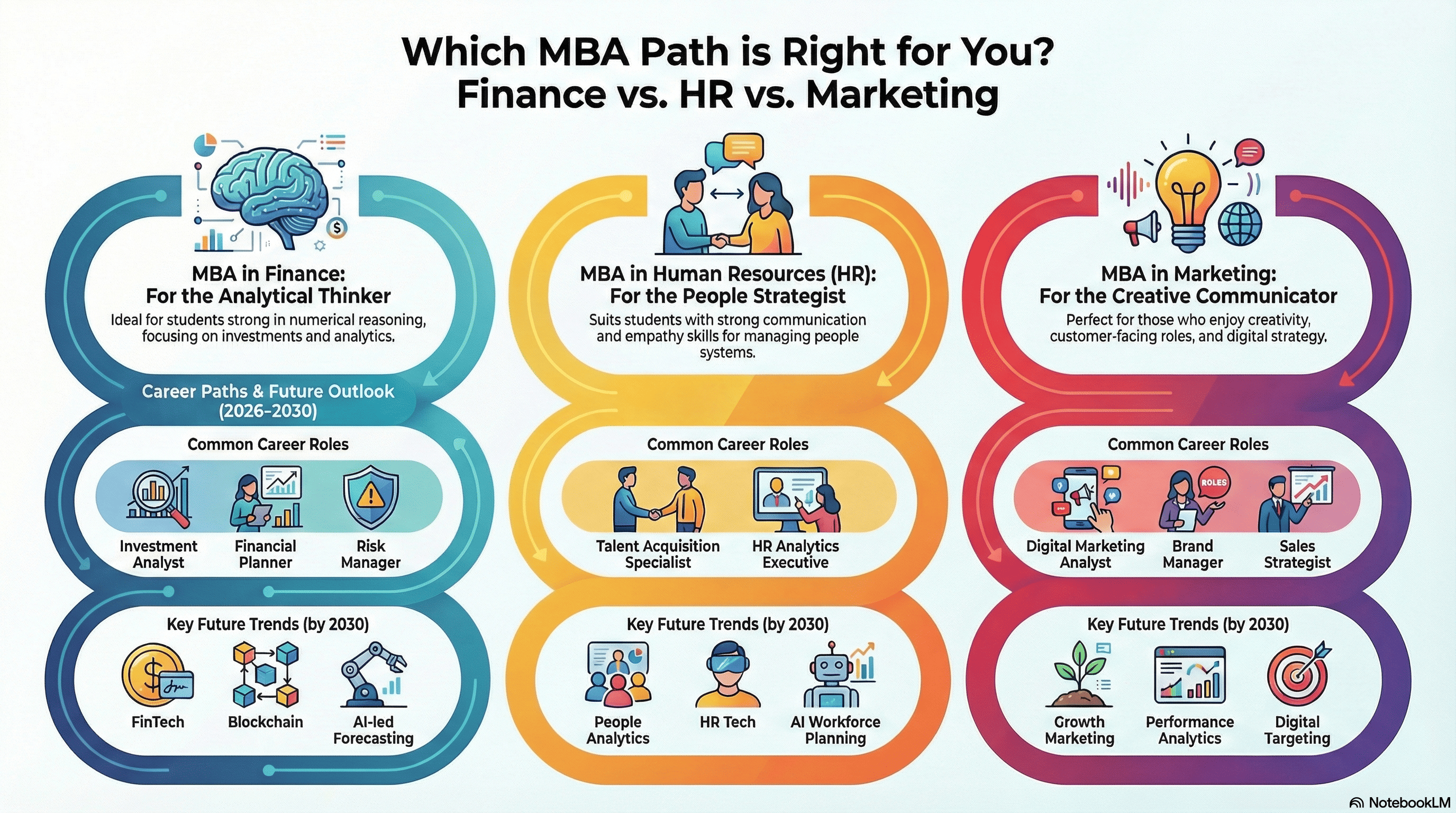
Between 2026 and 2030, the demand for management graduates will shift significantly as organisations adopt automation, analytics, digital-first operations, and hybrid workforce structures. For students exploring advanced business education, the choice of MBA specialisation directly impacts long-term roles, salary potential, and industry mobility. Whether studying full-time or through a recognised ODL format, learners increasingly want clarity on how each domain — Marketing, HR, or Finance — aligns with emerging trends.
Universities today focus on showing how each specialisation responds to evolving market forces rather than presenting them as static options. This distinction helps students make career decisions from an informed and future-oriented perspective.
- Why Choosing the Right MBA Specialisation Matters
- MBA in Finance vs MBA in HR: A Detailed Comparison
- MBA in Finance: Career Scope & Salary
- MBA in HR: Career Scope & Salary
- MBA in Marketing: Who Should Choose It?
- Which MBA Specialisation Is Best for the Future (2030 Outlook)?
- After an MBA in HR, What Should You Study Next?
- Is Doing an MBA in Correspondence Worth It in 2026?
- Why Choose CCS University Distance MBA (ODL)?
- Distance MBA Admission Process at CCS University
- Final Guidance: Which MBA Specialisation Should You Choose?
- FAQs
Why Choosing the Right MBA Specialisation Matters
Students often seek MBA specialisation comparison because career growth differs widely across Marketing, HR, and Finance, depending on industry cycles and economic behaviour. The right specialisation influences not just the job you get after graduation but also the roles you grow into over time. As companies adopt data-driven operations, each function now requires deeper analytical ability, stronger communication skills, and strategic thinking. This means that specialisation is less about preference and more about alignment with skills, interests, and career ambition. Understanding this distinction helps learners avoid choosing based on trends alone.
What Influences Specialisation Decision?
- Long-term career direction and leadership goals
- Industry demand in the next five to seven years
- Skill alignment with job responsibilities
- Salary variation across functions
The right choice strengthens career stability while offering growth across changing business environments.
MBA in Finance vs MBA in HR: A Detailed Comparison
The question MBA in Finance or HR – which is better, reflects a common dilemma among learners aiming for managerial roles. Finance offers analytical and numbers-driven positions, while HR focuses on people systems, talent strategy, and organisational development. Each path has distinct responsibilities, salary patterns, and long-term opportunities. As industries modernise, Finance benefits from automation and digital finance tools, while HR gains importance in managing hybrid teams and people analytics. Choosing between the two depends on whether a student is inclined towards analytical calculations or human behaviour understanding.
Key Differences
- Finance involves investments, budgeting, analytics, and corporate forecasting
- HR revolves around workforce planning, training, employee engagement, and compliance
- Finance is ideal for students strong in numerical reasoning
- HR suits students with communication, empathy, and people-management skills
Both domains offer growth, but success depends on personality strengths and professional interest.
MBA in Finance: Career Scope & Salary
The discussion around MBA HR or Finance salary often highlights that Finance roles usually begin with structured pay scales due to their technical nature. Finance professionals contribute to critical areas such as risk management, corporate finance, banking operations, and financial planning. These roles benefit from steady market demand and predictable growth trajectories, especially in BFSI, consultancy, and analytics-driven organisations. Over time, Finance graduates transition into strategic positions involving investment decisions and financial leadership.
Career Roles in Finance
- Corporate Finance Executive
- Banking and Investment Analyst
- Financial Planner or Credit Manager
- Risk and Compliance Specialist
The salary trajectory is strong, particularly for students who build expertise in financial tools and analytics.
MBA in HR: Career Scope & Salary
The HR domain is evolving rapidly due to the integration of HR analytics, digital HR tools, and workforce automation. HR graduates manage recruitment, performance, training, compensation, and employee experience, ensuring organisational stability. Long-term salary and growth depend on a candidate’s ability to manage people processes across complex business environments. HR roles are increasingly strategic rather than administrative, especially in large enterprises adopting hybrid workplace models.
Career Roles in HR
- HR Executive or HR Generalist
- Talent Acquisition Specialist
- HR Analytics Executive
- Learning & Development Coordinator
HR offers stable progression for students who excel in communication, empathy, and organisational behaviour.
MBA in Marketing: Who Should Choose It?
Students researching MBA Marketing, HR, and Finance often want clarity on whether Marketing suits their personality and career goals. Marketing is ideal for those who enjoy communication, creativity, analytics, and customer-facing roles. With digital platforms expanding rapidly across India, marketing is no longer limited to sales — it now includes digital strategy, performance marketing, brand management, and customer insights. This specialisation provides strong mobility across industries such as FMCG, retail, e-commerce, hospitality, and media.
Marketing Roles
- Digital Marketing Analyst
- Brand Management Associate
- Sales Strategy Coordinator
- Social Media and Campaign Planner
Marketing suits students who enjoy dynamic environments and customer-driven strategy development.
Have something specific in mind?
You Can Reach Out to Us →Which MBA Specialisation Is Best for the Future (2030 Outlook)?
Students often search for the best MBA specialisation for the future to understand which domain aligns with emerging trends and industry disruptions. Finance will benefit from FinTech, automation, AI-led forecasting, and analytics-based financial decision-making. HR will strengthen through HR Tech, people analytics, and organisational behaviour intelligence. Marketing will grow through digital transformations, advanced targeting models, and performance analytics. Each specialisation thrives differently based on technological adoption.
Future 2030 Trends
- Finance: Blockchain, digital payments, risk analytics
- HR: People analytics, AI-driven workforce planning
- Marketing: Growth marketing, performance analytics
The best specialisation depends on whether a student prefers numbers, people, or creative strategy.
After an MBA in HR, What Should You Study Next?
After completing HR specialisations, students often explore additional certifications to strengthen their profile for leadership roles. Upskilling in analytics, HR digital systems, labour laws, or behavioural science helps HR professionals navigate modern workplace demands. Many graduates further pursue research pathways or academic positions through NET/PhD options. Continuous learning keeps HR graduates competitive in evolving organisational structures.
Next Study Options
- HR Analytics and HR Tech certifications
- Executive MBA for senior leadership pathways
- Labour law compliance programmes
- Research options like a PhD or NET
The next step depends on whether the student aims for leadership roles or specialised HR expertise.
Is Doing an MBA in Correspondence Worth It in 2026?
Students often ask whether an MBA correspondence is worth it due to changing workforce expectations and flexible learning preferences. Distance and ODL degrees are now recognised when offered by UGC-approved universities, making them valid for employment and higher studies. This model suits working professionals, individuals preparing for career transitions, and students in tier-2/3 cities who want to study without relocating. Distance MBA offers structured study while accommodating professional responsibilities.
Benefits of Distance MBA
- Flexibility alongside work commitments
- Lower financial burden compared to full-time programmes
- Recognised by employers when from approved institutions
- Ideal for learners balancing multiple responsibilities
Correspondence mode offers strong value for students seeking academic continuity without full-time constraints.
Why Choose CCS University Distance MBA (ODL)?
Students exploring an MBA ODL program often look for reliability, academic structure, and regional accessibility. As a UGC-DEB recognised public university, CCSU provides an established framework for distance learning supported by local study centres and exam facilities. Its affordability and credibility make it a preferred choice for students across Delhi NCR and Western UP. The programme remains accessible for working professionals, homemakers, and graduates who need flexible scheduling.
Why CCSU ODL Stands Out
- Public university with UGC-DEB approval
- Reasonable fee structure
- Local exam centres across Western Uttar Pradesh
- Valid for government and private sector opportunities
CCSU offers a stable academic environment with flexibility suited to regional learners.
Distance MBA Admission Process at CCS University
Students searching for an MBA from CCS University often want clarity on how admission works. The process is straightforward and designed to support working professionals as well as fresh graduates. Required documents include academic transcripts, identity proofs, and recent photographs. Admission cycles typically operate twice a year, depending on university guidelines.
Admission Steps
- Ensure eligibility: a recognised bachelor’s degree
- Submit the application with the required documents
- Receive confirmation and study materials
- Begin coursework through the ODL platform
The admission process is structured to make the transition into distance learning smooth and accessible.
Final Guidance: Which MBA Specialisation Should You Choose?
The answer to MBA in Finance or HR, which is better depends entirely on a student’s interests, strengths, and long-term professional goals. Finance is ideal for analytical thinkers; HR suits those who understand human behaviour; Marketing works best for creative strategists. Location also matters—students in Delhi NCR, Meerut, Ghaziabad, Muzaffarnagar, Saharanpur, Hapur, and Noida may prefer ODL due to work commitments and local exam support. A balanced evaluation of skills, ambition, and lifestyle leads to the right specialisation choice.
Guidance Framework
- Choose Finance for analytical and numerical roles
- Choose HR for people-oriented strategic roles
- Choose Marketing for dynamic, customer-driven functions
- Choose ODL if balancing work, travel, or family responsibilities
The best MBA specialisation is the one that aligns naturally with how you think, work, and plan your future.
FAQs
Both are viable; Finance suits analytical roles, while HR suits people-management roles based on career goals.
Yes, CCSU’s ODL MBA is valid across Meerut, Muzaffarnagar, Saharanpur, Hapur, Noida, and Ghaziabad.
HR Analytics, Talent Acquisition, L&D Specialist, and HR Operations roles are commonly available.
Yes, correspondence MBA offers flexibility, recognition, and work-study balance for professionals.
Finance typically leads in structured salary growth, followed by Marketing roles in digital sectors.
Yes, the ODL format allows students in these regions to study without leaving their jobs.